Search
Climate change and cropland management compromise soil integrity and multifunctionality

 October 26, 2023 | Communications Earth & Environment 

Introduction: Researchers from German Centre for Integrative Biodiversity Research investigated the impact of climate change and land use on multiple soil functions, utilizing both observational and experimental data. The research assessd whether results from manipulative field experiments align with observed trends in climate, land use, and soil multifunctionality across Europe, which involved measuring seven ecosystem functions, such as microbil respiration, microbial biomass, etc.

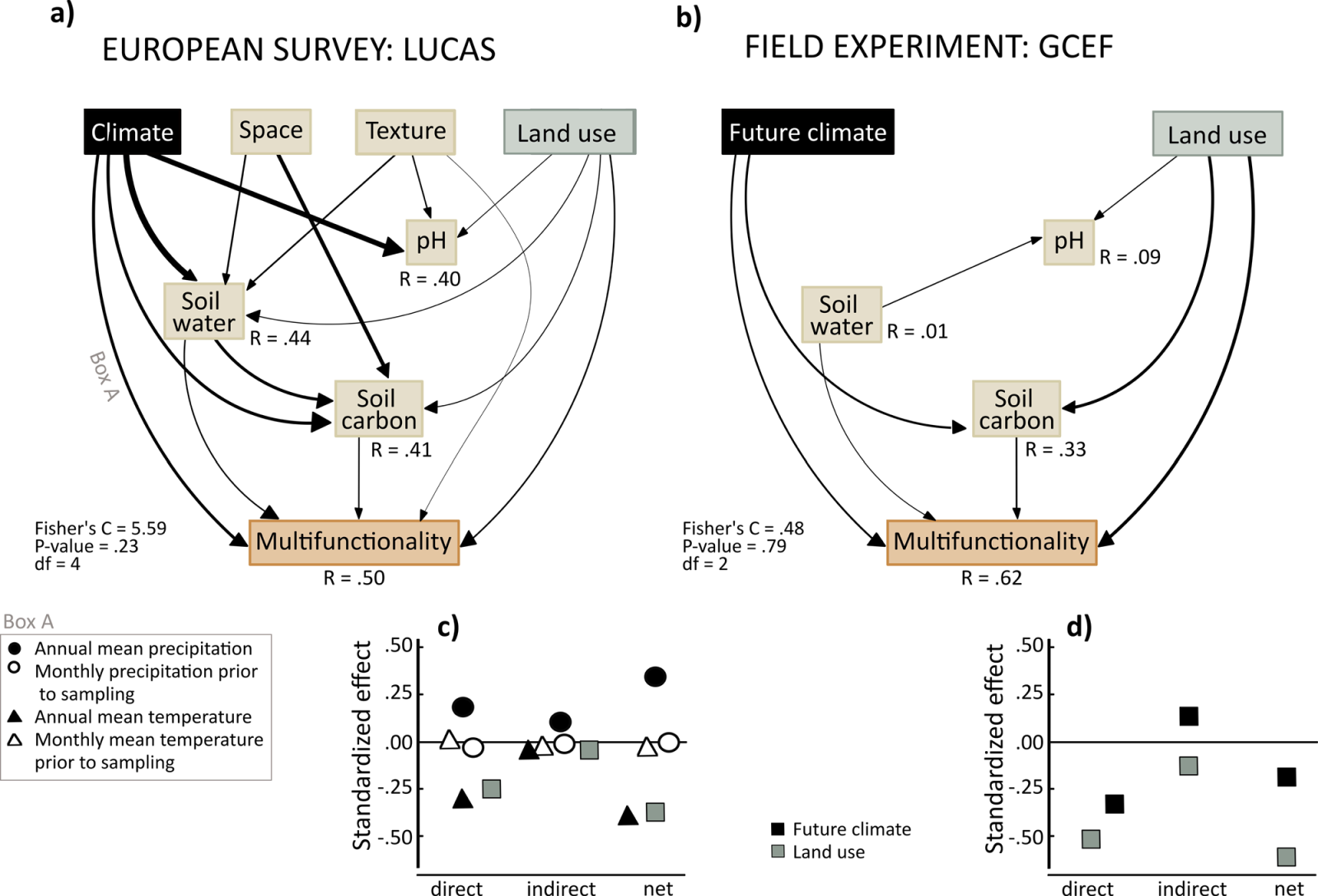
Key findings: The observational data revealed a Europe-wide decline in soil multifunctionality associated with rising temperatures and dry conditions, and such decline was exacerbated by cropland management. The experimental data supported these findings, indicating that climate-induced changes will likely reduce soil multifunctionality in croplands and grasslands. The conversion of grasslands to croplands was identified as a threat to soil system integrity. The study emphasized the importance of enhancing soil multifunctionality in arable systems to preserve soil functions amid changing climate conditions.
Read more


Fig. | Structural Equation Models showing the results from two complementary studies on the effects of climate (change) and land use (cropland versus grassland) on soil multifunctionality.  


Viewed Articles
Climate change and cropland management compromise soil integrity and multifunctionality
 October 26, 2023 | Communications Earth & Environment |  Introduction: Researchers from German Centre for Integrative Biodiversity Research investigated the impact of climate change and land use on m
Read More
Quantifying the impact of climate smart agricultural practices on soil carbon storage relative to conventional management
January 15, 2024 | Agricultural and Forest Meteorology | Introduction: Claims that climate-smart agricultural practices sequester atmospheric carbon more effectively than conventional approaches lack
Diversifying crop rotation increases food production, reduces net greenhouse gas emissions and improves soil health
January 3, 2024 | Nature Communications | Source | Introduction: Conventional intensive farming boosts yields but also drives GHG emissions, soil degradation, and climate vulnerability, especially in
Optimizing cover crop practices as a sustainable solution for global agroecosystem services
November 14, 2024 | Nature Communications | Introduction: Cover crops offer multiple agroecosystem benefits including higher yields, soil carbon storage, and erosion control, but their net value is co
How to measure, report and verify soil carbon change to realize the potential of soil carbon sequestration for atmospheric greenhouse gas removal
August 30, 2019 | Global Change Biology |  Introduction: This paper is produced by an international consortium of researchers across Europe, North America, Oceania and Africa, reflecting broad experti
Greenhouse gas emissions and carbon sequestration in organic dehesa livestock farms. Does technical-economic management matters?
October 20, 2022 | Journal of Cleaner Production | Source |  Introduction: While organic livestock systems are often hailed as environmentally friendly, their greenhouse gas (GHG) emissions and carbon
TOP