NOMAD: an EU project for sustainable agriculture development
June 13, 2023 | Earth.org |
NOMAD, an EU-funded research project, aims to promote sustainable agriculture and address the environmental impact of synthetic fertilizers by developing biofertilizers and implementing a circular economy approach. Synthetic fertilizers, although crucial for supporting the growing global population, have negative effects on the environment. They also require heavy natural gas usage, which can lead to price spikes and economic repercussions. To combat these issues, the European Union introduced the Fertilising Products Regulation, which aims to simplify access to innovative organic fertilizers derived from recycled waste and by-products. These standards encourage balanced fertilization, sustainable nutrient management, and reduced reliance on natural gas. Additionally, the European Commission proposed guidelines to support resilient and sustainable agriculture and increase organic waste and nutrient recycling. The NOMAD project, involving experts and partners from eight countries, has developed a scalable technology to convert organic waste into high-performance biofertilizers. Pilot sites in Greece, Italy, Malta, and the UK have been chosen to test the technology's effectiveness. The project's goal is to establish a local circular economy based on agriculture and food production and facilitate sustainable agriculture development.
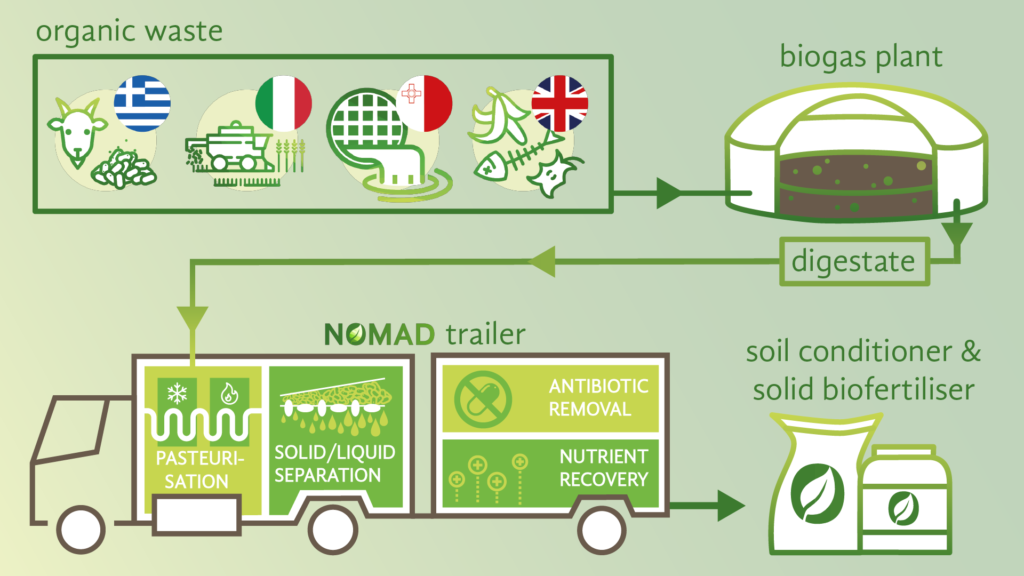
Source: NOMAD
Viewed Articles
June 13, 2023 | Earth.org |NOMAD, an EU-funded research project, aims to promote sustainable agriculture and address the environmental impact of synthetic fertilizers by developing biofertilizers and
July 04, 2024 | Carbon Market Watch | The European Commission is considering an EU Emissions Trading System (ETS) for agriculture to address the sector's persistently high carbon footprint, which
Read More
August 7, 2025 | Central News Agency (CNA) (In Chinese) | Taiwan’s Taoyuan District Agricultural Research and Extension Station (TYDARES), Ministry of Agriculture (MOA) has introduced 3 circular agr
November 21, 2025 | Food and Agriculture Organization (FAO) | At COP30, FAO positioned agrifood systems as a central pillar of climate mitigation, adaptation, and resilience strategies. FAO emphasized
October 22, 2025 | World Bank | The World Bank has launched a major initiative to support Ukraine’s smallholder farmers through conflict recovery and climate pressures, centered on the Partial Credit
July 31, 2025 | Agroberichten Buitenland (Nieuwsbericht) | Livestock waste, which makes up nearly 80% of global agricultural waste, is a major source of water pollution, soil degradation and GHG emis
July 31, 2025 | New Security Beat (Wilson Center’s Environmental Change and Security Program blog) | Japan and China are advancing the conversion of food waste into animal feed to cut methane emissio