Search
A real-time smart sensing system for automatic localization and recognition of vegetable plants for weed control
Sources of information

Frontiers in Plant Science | Mar 27, 2023

Researchers at China Agricultural University have developed a smart weeder to combat weed threats in tomato production. Weeds pose a significant challenge, particularly during the early stages of tomato plant growth. To address this, the team created an integrated sensing system using cameras and color mark sensors. The system accurately locates tomato and pakchoi plants in real time, crucial for effective weed management.

Through experiments, the researchers determined that using the main stem of tomato plants as a reference yielded better results than pakchoi. Applying white markers on the lower main stem of tomato plants proved optimal. The system, equipped with six sensors, demonstrated high efficiency in detecting plant labels. A specially designed computer vision algorithm achieved an impressive overall accuracy of 95.19% in localizing tomato and pakchoi plants.

This sensor-based system offers a reliable and precise solution for automatic real-time localization of vegetable plants, enabling effective weed control in agriculture.
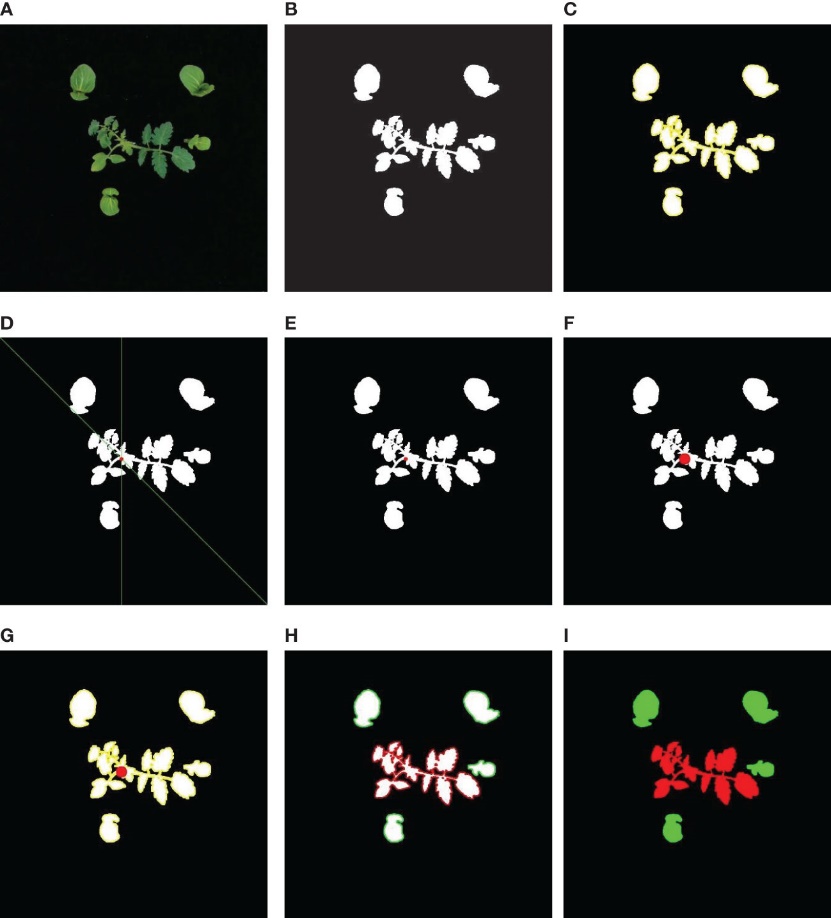
*
(A) Image of tomato plant and weeds captured by the system, (B) binary image after morphological operations, (C) binary image with plants contours (yellow), (D) position of the crop signal in the RGB image, (E) position of crop signal in the binary image, (F) crop signal tolerance bands in the binary image, (G) the contours of plants (yellow) and the crop signal tolerance bands (red) in the binary image, (H) the contours of tomato plant (red) and the contours of weeds (green), (I) pixel mapping of weeds (green) and crop plants (red).


Viewed Articles
A real-time smart sensing system for automatic localization and recognition of vegetable plants for weed control
Frontiers in Plant Science | Mar 27, 2023Researchers at China Agricultural University have developed a smart weeder to combat weed threats in tomato production. Weeds pose a significant challenge, par
Read More
Enviromic assembly increases accuracy and reduces costs of the genomic prediction for yield plasticity in maize
March, 2024 | Frontiers in Plant Science |  Introduction: Developing climate-smart agriculture requires cost-effective methods to characterize crop growing conditions. A research team from the America
Adapting crop production to climate change and air pollution at different scales
October 16, 2023 | Nature Food |  Introduction: Air pollution and climate change are interconnected challenges that impact field crop production and agroecosystem health. Adapting crop production to t
Digital mapping of the soil available water capacity: tool for the resilience of agricultural systems to climate change
July 15, 2023 | Science of The Total EnvironmentSoil plays a crucial role in agriculture, but understanding its water-holding capacity, called available water capacity (AWC), can be challenging. Tradi
Precise irrigation water and nitrogen management improve water and nitrogen use efficiencies under conservation agriculture in the maize-wheat systems
July 26, 2023 | Scientific Reports |  Introduction: Over a three-year field experiment aimed at addressing underground water depletion and ensuring agrifood system sustainability, researchers from Int
Climate change impacts on crop breeding: Targeting interacting biotic and abiotic stresses for wheat improvement
July 06, 2023 | The Plant Genome |  Introduction: Researchers from CIMMYT (Mexico) and Mamoré Research and Innovation (UK) address a critical gap in wheat breeding research: the limited consideration
TOP